In Silico Molecular Cloning: Principles, Methods, and Workflows
In silico molecular cloning is the computational modeling, simulation, and verification of recombinant DNA constructs prior to physical wet-lab manipulation. By executing enzymatic restriction digestions, multi-fragment homologous assemblies, and open reading frame (ORF) translations in a digital environment, molecular biologists can systematically identify design errors—such as cryptic internal restriction sites, frame shifts, and secondary structure interference—before procuring oligonucleotides or dispensing enzymes. This foundational guide details the core biochemical principles, algorithmic foundations, and standard computational workflows governing modern in silico cloning.
The Evolution of In Silico Cloning in Modern Biotechnology
Historically, recombinant DNA construction was planned on paper or simple text editors, with researchers manually searching sequences for restriction recognition hexanucleotides (such as EcoRI: 5'-GAATTC-3' or HindIII: 5'-AAGCTT-3') and manually verifying codon triplets. As synthetic biology progressed toward synthetic metabolic pathways, multi-target CRISPR interference constructs, and antibody fragment engineering, construct complexity exceeded the capacity of manual verification.
Modern in silico cloning platforms, exemplified by ZettaGene, serve as virtual bio-foundries. They simulate the exact thermodynamic and enzymatic mechanics of diverse assembly chemistries, providing researchers with three primary operational advantages:
- Defensive Bio-Design: Identifies lethal design flaws—such as an unintended termination codon introduced in a linker peptide or an internal Type IIS cleavage site—within milliseconds.
- Automated Oligo Derivation: Derives physical PCR primers with thermodynamically matched melting temperatures (\(T_m\)) and specified 5' overhang tails directly from the digital construct boundaries.
- Permanent Digital Provenance: Generates fully annotated GenBank-compliant construct files that capture every cloning junction, assembly method, and functional feature for downstream electronic notebook archiving.
Core Computational Principles of In Silico Assembly
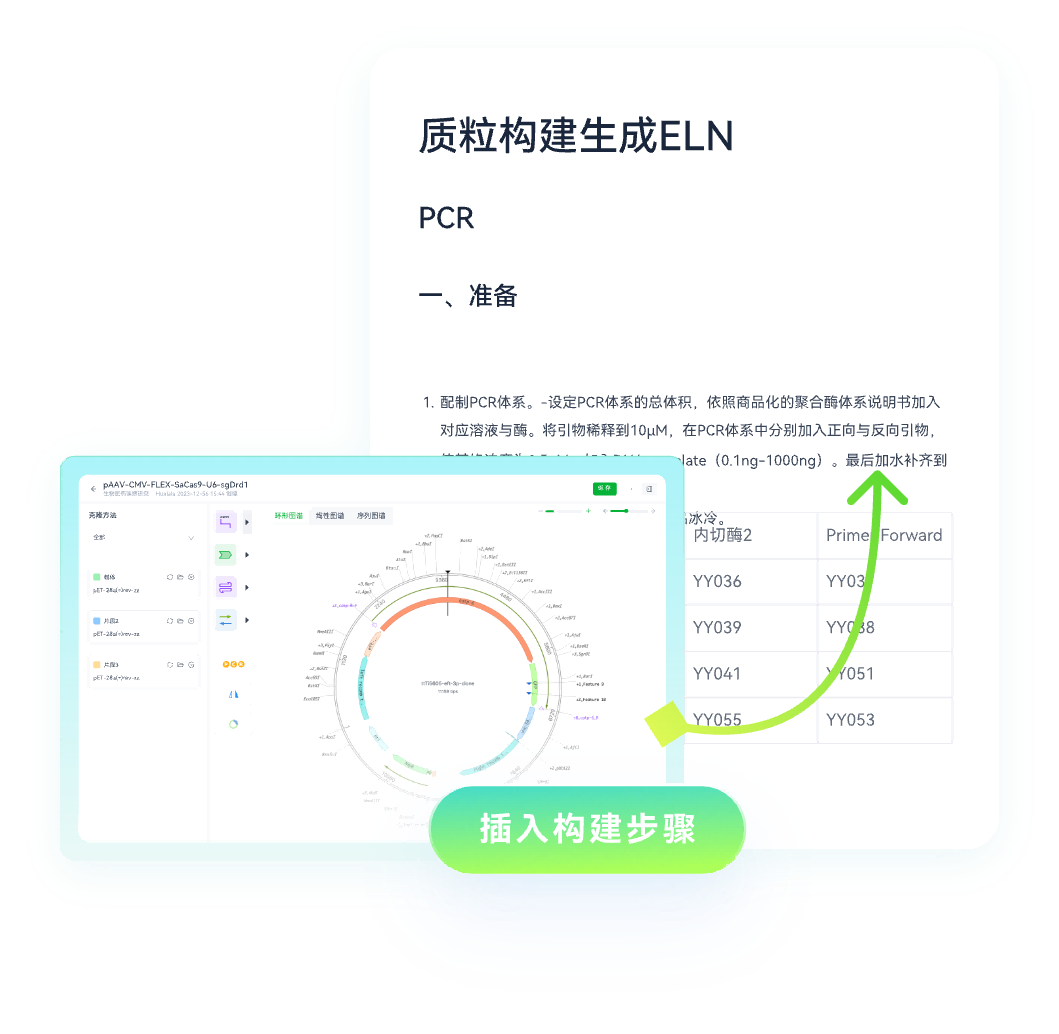
In silico cloning engines operate through specific computational algorithms that simulate discrete molecular biology chemistries:
| Cloning Assembly Method | Simulated Enzymatic Kinetics | Computational Verification Algorithms |
|---|---|---|
| Restriction-Ligation Cloning | Site-specific phosphodiester cleavage by Type II endonucleases; hydrogen bonding of cohesive overhangs; covalent ligation by T4 DNA ligase. | Pattern-matching search against REBASE database; overhang compatibility validation; vector dephosphorylation simulation. |
| Type IIS Assembly (Golden Gate / MoClo) | Cleavage outside the non-palindromic recognition sequence; generation of non-palindromic 4-bp overhangs; simultaneous digestion and ligation. | Overhang fidelity and cross-ligation prediction; detection of internal recognition sites; modular part boundary compliance. |
| Homologous Recombination (Gibson / In-Fusion) | 5' to 3' exonuclease chewing; single-strand annealing of 20–40 bp homologous overhangs; polymerase fill-in and nick ligation. | Homology arm thermodynamic annealing calculations; delta G prediction for hairpin and self-dimer structures at 50°C. |
| Site-Directed Mutagenesis | PCR amplification across a target plasmid using overlapping or back-to-back mutagenic primers containing mismatches. | Nearest-neighbor SantaLucia mismatch thermodynamics; DpnI digestion simulation to model parental methylated template elimination. |
Step-by-Step In Silico Cloning Workflow Architecture
A rigorous in silico cloning protocol follows five sequential computational phases:
Phase 1: Feature Annotation and Sequence Curation
Before simulating assembly, the destination vector backbone (retrieved from the Plasmid Library or GenBank) must undergo feature curation. The software identifies and validates core genetic elements:
- Origin of Replication (ori): High-copy (e.g., pUC ori) vs low-copy (e.g., pBR322 or p15A), determining copy number control in bacterial hosts.
- Selectable Markers: Antibiotic resistance cassettes (e.g., Ampicillin/bla, Kanamycin/aph, Chloramphenicol/cat) or eukaryotic selection markers (Puromycin, G418).
- Promoter Elements: Bacterial (T7, lac, tac) vs mammalian (CMV, EF1alpha, CAG) promoters, confirming host compatibility.
Phase 2: Insert Boundary and Reading Frame Verification
When engineering fusion proteins or cloning cDNAs downstream of an N-terminal tag (e.g., 6xHis, FLAG, or EGFP):
- The software tracks the open reading frame starting from the initiator ATG codon across all intervening multiple cloning site (MCS) codons.
- The user confirms that the number of nucleotides separating the tag from the insert cDNA is a multiple of 3 (\(3n\)). A separation of \(3n+1\) or \(3n+2\) bases results in an immediate frameshift mutation, converting the downstream protein into non-functional nonsense peptides.
- ZettaGene provides dynamic multi-frame visual translation tracks that highlight peptide translations across all six reading frames simultaneously.
Phase 3: Enzymatic and Homology Simulation
Depending on the selected assembly modality, the engine executes virtual enzymatic actions:
- Restriction Cloning: The algorithm cleaves the double-stranded DNA at specified restriction coordinates, generates distinct 5' or 3' single-stranded overhang strings, and tests whether the insert overhangs are strictly complementary to the vector termini.
- Golden Gate Assembly: The engine scans the insert for internal Type IIS cut sites (e.g., BsaI: 5'-GGTCTC-3'). If internal sites are detected, the domesticator module proposes silent point mutations that destroy the restriction motif without altering the encoded amino acid sequence.
Phase 4: Automated Primer Derivation and Thermodynamics
Once the digital construct is formed, the software computes optimal PCR primers required to amplify the physical insert:
5' Primer = [Overhang Tail (Restriction site / Gibson Homology)] + [Annealing Core (Gene Specific)]
The annealing core is calculated using the SantaLucia unified nearest-neighbor thermodynamic model, incorporating monovalent salt (\(ext{Na}^+\)) and divalent cation (\(ext{Mg}^{2+}\)) corrections to ensure a melting temperature (\(T_m\)) of 58°C–62°C. Primers forming stable secondary hairpins (\(\Delta G < -4.0ext{ kcal/mol}\)) are automatically flagged for boundary adjustment.
Phase 5: Diagnostic Restriction Verification (Virtual Gel)
To prepare for post-cloning wet-lab screening, the engine generates an in silico diagnostic digestion map. Selecting two or three enzymes predicts exact fragment lengths, rendering a simulated agarose gel electrophoresis profile that bench scientists use to confirm positive clones.
Failure Diagnosis: Traps in Computational Sequence Design
In silico cloning models chemistry; it does not eliminate human biological oversight. Watch for these common pitfalls:
| In Silico Design Trap | Underlying Biological Consequence | Computational Verification Protocol |
|---|---|---|
| Overlooking Mammalian Kozak Context | Cloning a eukaryotic cDNA lacking a consensus Kozak sequence (GCCACC-ATG) results in severely attenuated protein translation efficiency. | Inspect the -6 to +4 nucleotide window relative to the translation start site; ensure a purine (A or G) occupies position -3. |
| Accidental Stop Codon in C-Terminal Tags | Failing to delete the endogenous stop codon (TAA, TAG, TGA) of the insert cDNA prevents translation of downstream C-terminal tags. | Verify that the insert coding sequence terminates with a sense codon before joining the linker and C-terminal tag. |
| Methylation Sensitivity Clashes | Selecting restriction enzymes whose cut sites overlap Dam (GATC), Dcm (CCAGG), or CpG methyltransferase targets causes cleavage failure in standard E. coli strains. | Enable methylation sensitivity warnings in ZettaGene; switch to methylation-insensitive isoschizomers or use Dam-/Dcm- competent cells. |
Connecting In Silico Models to the Wet Lab
The true value of in silico cloning is realized when the digital model actively governs wet-lab execution. Rather than leaving the verified construct file isolated on a personal laptop, integrating ZettaGene with ZettaNote enables bench scientists to instantiate verified protocols directly from the plasmid map, tracking reagent lots and attaching final Sanger sequencing chromatograms directly to the digital model.
References
- Sambrook, J., & Russell, D. W. (2001). Molecular Cloning: A Laboratory Manual (3rd ed.). Cold Spring Harbor Laboratory Press. ISBN: 978-0879695774.
- Engler, C., Kandzia, R., & Marillonnet, S. (2008). A one pot, one step, precision cloning method with high throughput capability. PLoS ONE, 3(11), e3647. DOI: 10.1371/journal.pone.0003647.
- Gibson, D. G., et al. (2009). Enzymatic assembly of DNA molecules up to several hundred kilobases. Nature Methods, 6(5), 343-345. DOI: 10.1038/nmeth.1318.
- Kozak, M. (1987). An analysis of 5'-noncoding sequences from 699 vertebrate messenger RNAs. Nucleic Acids Research, 15(20), 8125-8148. DOI: 10.1093/nar/15.20.8125.
Related Articles