DNA Design and Analysis Software — Which Capabilities Matter Most?
The Role of DNA Design and Analysis Software in Research
DNA design and analysis software serves as the digital workbench for molecular biologists, geneticists, and synthetic biology teams. From designing a single PCR primer to annotating an entire eukaryotic genome, these tools translate raw sequence data into actionable biological insights. Choosing the right software—understanding what each category excels at and where gaps exist—can meaningfully accelerate research timelines.
This article examines the major functional categories, highlights evaluation criteria, and explores how integrated platforms like ZettaGene are reshaping the DNA software landscape.
Categories of DNA Design Software
Primer Design and Optimization
Primer design is the most universally needed function in molecular biology. Tools in this category accept a target template sequence and output primer pairs optimized for melting temperature, GC content, amplicon length, and secondary-structure avoidance. Algorithms rooted in Primer3 remain the gold standard, but commercial wrappers add graphical interfaces, batch processing, and method-specific presets for cloning techniques like Gibson Assembly and Golden Gate.
For high-throughput projects, look for tools that support primer pool design with degeneracy scoring and cross-dimer checks—features that prevent costly PCR failures when amplifying dozens of targets simultaneously.
Plasmid and Vector Construction
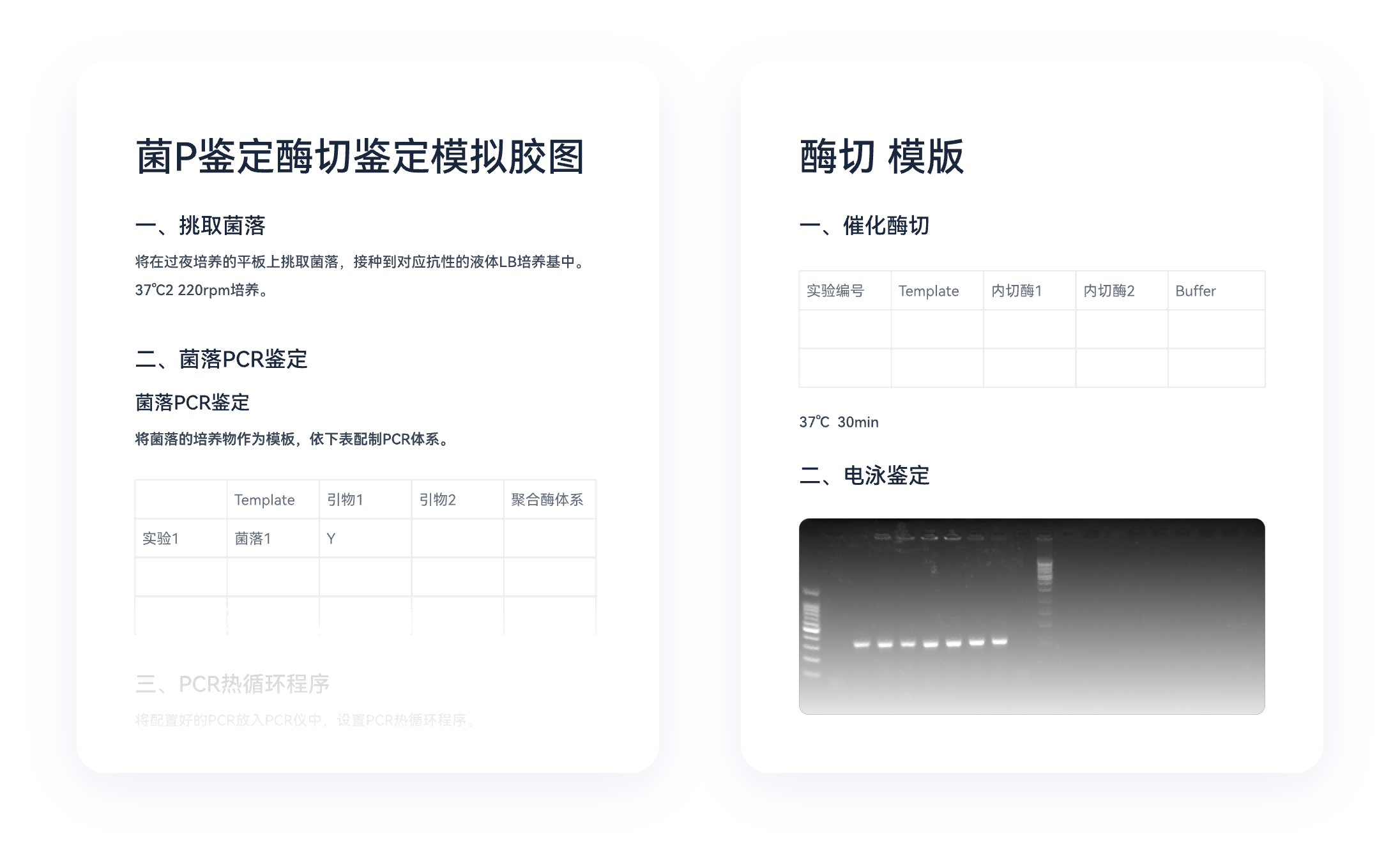
Plasmid design tools let researchers assemble DNA constructs by dragging fragments into a visual workspace. Key capabilities include restriction site mapping, open reading frame verification, codon optimization, and multi-fragment assembly simulation. Cloud-native tools add template libraries, version history, and one-click ordering of synthetic DNA.
ZettaGene provides plasmid construction with direct links to downstream applications: once a construct is finalized, users can route the sequence to CRISPR guide design via ZettaCRISPR or log the experiment in ZettaNote, the platform's electronic lab notebook, without manual export steps.
Synthetic Biology and Gene Circuit Design
Synthetic biology demands tools that go beyond traditional cloning. Specialized platforms support combinatorial part libraries, logic gate modeling, and codon optimization for heterologous expression systems. Some tools simulate transcription and translation kinetics, helping researchers predict construct behavior before synthesis.
Categories of DNA Analysis Software
Sequence Alignment and Comparison
Pairwise and multiple sequence alignment form the backbone of comparative genomics. BLAST remains the standard for homology searching, while tools like MUSCLE, MAFFT, and Clustal Omega handle multiple alignments with varying speed-accuracy trade-offs. For clinical or regulated settings, validated alignment pipelines with audit trails are essential.
Genome Annotation and Variant Calling
Genome viewers such as IGV and the UCSC Genome Browser let researchers visually explore sequencing data alongside gene annotations, epigenetic marks, and structural variants. Variant calling pipelines identify single-nucleotide polymorphisms, insertions, and deletions, typically integrating with reference databases like dbSNP and ClinVar for clinical interpretation.
Next-Generation Sequencing Analysis
NGS analysis platforms handle the full pipeline from raw reads to biological interpretation: quality control, read alignment, variant calling, and functional enrichment. Cloud-based solutions like Illumina DRAGEN and BaseSpace Sequence Hub reduce the computational burden on local infrastructure while maintaining analytical rigor.
Feature Comparison: Design vs. Analysis Tools
| Capability | Design Tools | Analysis Tools | Integrated Platforms |
|---|---|---|---|
| Primer design | ✅ Core | ❌ | ✅ |
| Plasmid mapping | ✅ Core | ⚠️ Limited | ✅ |
| Sequence alignment | ⚠️ Basic | ✅ Core | ✅ |
| Variant calling | ❌ | ✅ Core | ✅ |
| ELN integration | ⚠️ Rare | ⚠️ Rare | ✅ |
| CRISPR design link | ⚠️ Rare | ❌ | ✅ |
Key Evaluation Criteria
- Format support: GenBank, FASTA, EMBL, SBOL for design; BAM, VCF, FASTQ for analysis
- Collaboration: Real-time co-editing, shared template libraries, role-based access
- Scalability: Performance with large genomes and high-volume batch operations
- Integration: API connections to LIMS, ELN, sequencing instruments, and downstream tools
- Compliance: Data encryption, audit logs, GDPR/HIPAA adherence for regulated workflows
- Total cost: License structure (per-seat vs. per-feature), open-source alternatives, and hidden costs like training and support
The Integrated Platform Advantage
Standalone tools excel at specific tasks but create friction at workflow boundaries. Exporting a construct from a design tool, importing it into a CRISPR design application, and then manually recording the protocol in a separate ELN introduces errors and slows progress. Integrated DNA software platforms eliminate these handoff points.
ZettaLab's suite—comprising ZettaGene for sequence design and analysis, ZettaCRISPR for gene editing, and ZettaNote for electronic documentation—provides a unified environment where data flows seamlessly between stages. Researchers can design a construct, verify it with in silico analysis tools, generate editing guides, and document every step in a single platform with full traceability.
Conclusion
DNA design and analysis software is no longer a collection of niche utilities—it is the operational backbone of modern molecular biology. By understanding the functional categories, comparing capabilities, and prioritizing integration, research organizations can select tools that not only meet today's needs but scale with the ambitions of tomorrow's genomic research. Platforms that combine design, analysis, and documentation in a single ecosystem, such as ZettaLab, represent the direction the field is moving.
Related Articles