What Is Gene Construct Design Software and How to Choose It
What Is Gene Construct Design Software?
Gene construct design software enables molecular biologists to plan, visualize, and optimize DNA constructs before they are synthesized or assembled in the lab. These tools allow researchers to arrange genetic elements — promoters, coding sequences, tags, restriction sites, and terminators — into functional DNA molecules that can be inserted into host organisms for expression, knockout, or editing experiments.
The design phase is arguably the most impactful step in a molecular biology workflow. Errors in construct design — such as incorrect reading frames, unintended restriction sites, or suboptimal codon usage — can invalidate weeks of downstream experimental work. Gene construct design software reduces these risks by providing simulation, validation, and optimization capabilities that catch problems before they reach the bench.
Core Features of Modern Design Tools
Visual Sequence Editing
Graphical interfaces display DNA constructs as circular or linear maps with color-coded features. Users can drag and drop genetic elements, edit sequences directly, and see real-time updates to the construct map. This visual approach makes it easy to spot structural problems that would be difficult to identify in raw sequence text.
Tools like SnapGene and Geneious Prime have set the standard for intuitive visual design, while ZettaLab's ZettaGene platform brings similar capabilities into a cloud-based environment where teams can collaborate on construct designs in real time.
Cloning Strategy Simulation
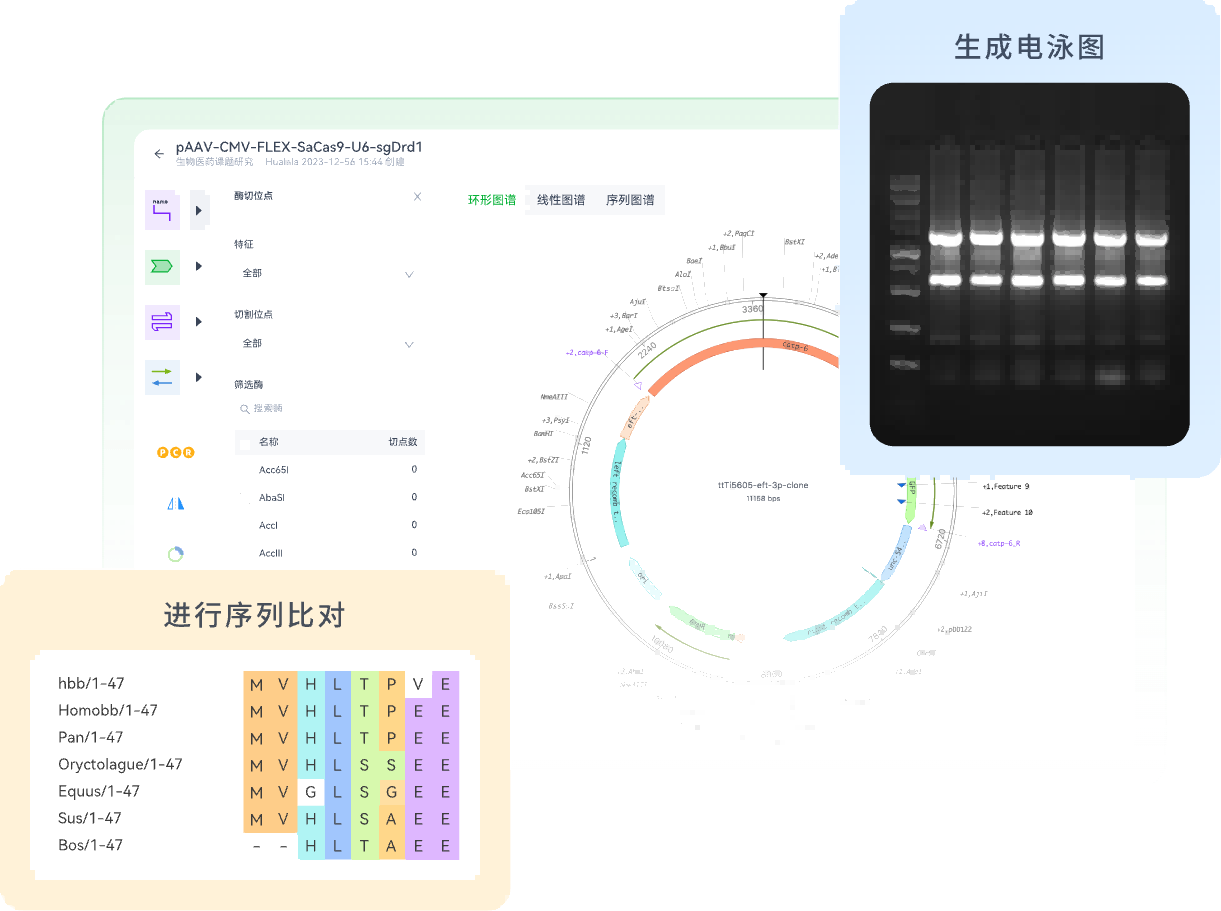
Before committing to a cloning method, researchers can simulate the entire process in software. Common cloning methods supported by design tools include:
- Restriction enzyme cloning: Select enzymes, predict fragment sizes, and verify compatible ends.
- Gibson Assembly: Design overlapping fragments and verify homology regions.
- Gateway cloning: Plan recombination reactions with attB/attP sites.
- Golden Gate Assembly: Design modular constructs with Type IIS restriction enzymes.
- In-Fusion cloning: Verify homology arms for seamless cloning.
Simulation catches issues such as internal restriction sites, incorrect fragment orientations, and frame shifts before any physical work begins.
Codon Optimization
When expressing a gene in a heterologous host, the codon usage of the original organism may not match the preferred codons of the expression system. Codon optimization tools rewrite the coding sequence to use host-preferred codons while preserving the amino acid sequence. Advanced optimizers also consider GC content, mRNA secondary structure, and avoidance of cryptic splice sites.
How Gene Construct Design Fits into R&D Workflows
| Stage | Activity | Software Role |
|---|---|---|
| Planning | Define construct architecture | Template selection, element arrangement |
| Design | Build and optimize sequence | Codon optimization, site removal |
| Validation | Check for errors | Restriction analysis, ORF verification |
| Documentation | Record design decisions | Export maps, annotate features |
| Ordering | Send sequences for synthesis | Export to vendor formats |
ZettaLab streamlines this entire workflow through its integrated platform. Researchers can design constructs in ZettaGene, document their decisions in ZettaNote (the platform's electronic lab notebook), and manage CRISPR-based editing strategies with ZettaCRISPR — all within the same cloud environment.
Free vs. Commercial Tools
Researchers have access to both free and commercial gene construct design tools, each with distinct advantages:
- Free tools: VectorBee, ApE, GenSmart Design, and Serial Cloner provide solid design capabilities at no cost. They are well-suited for individual researchers, academic labs, and straightforward constructs.
- Commercial tools: SnapGene, Geneious Prime, and Gene Designer offer more advanced features such as batch processing, extensive databases, and priority support. These tools are often preferred by teams managing complex or high-throughput design projects.
The choice between free and commercial tools often comes down to the complexity of the constructs and the level of collaboration required. For teams that need shared access, version control, and integration with other R&D tools, cloud-based commercial platforms like ZettaLab offer advantages that standalone desktop applications cannot match.
Collaboration and Data Management
Construct design is rarely a solo activity. Teams need to share designs, review each other's work, and maintain a centralized library of validated constructs. Cloud-based platforms address these needs by providing:
- Shared construct libraries: Centralized repositories where teams can store, search, and reuse validated designs.
- Role-based access control: Permissions that determine who can view, edit, or approve construct designs.
- Version history: Complete audit trails that track every change to a construct over time.
- Integration with ordering systems: Direct export to synthesis vendors in the correct format.
ZettaNote, ZettaLab's electronic lab notebook, connects directly to the construct design workflow. When a researcher finalizes a design, the sequence, map, and design rationale are automatically logged, creating a traceable record that satisfies both internal documentation and regulatory requirements.
Trends Shaping Construct Design
Several trends are reshaping how gene constructs are designed:
- AI-assisted design: Machine learning models suggest optimal promoter combinations, predict expression levels, and recommend codon optimization strategies based on training data.
- Modular cloning standards: Frameworks like MoClo and Golden Gate enable the rapid assembly of standardized genetic parts into novel constructs.
- Cloud-native workflows: Moving design, simulation, and documentation into unified cloud platforms eliminates the friction of transferring files between disconnected desktop applications.
ZettaLab supports these trends by offering cloud-based molecular biology research tools that integrate AI-powered features with team-based collaboration. The platform's AI capabilities extend to translation for scientific documents, enabling international research teams to work from shared design specifications regardless of language.
Getting Started with Construct Design
For teams evaluating gene construct design software, a practical starting point is to identify the most common cloning methods used in the lab and ensure the chosen tool supports robust simulation for those workflows. From there, prioritize platforms that offer cloud collaboration, electronic lab notebook integration, and construct library management — features that become essential as the team and project portfolio grow.
Related Articles