Integrating Plasmid Design Software With Electronic Lab Notebooks
Integrating plasmid design software with an electronic lab notebook means connecting the constructs, maps, and primer sets designed in silico directly to the experiment records that document their use, so that a result can be traced back to the exact construct version that produced it. Without integration, the design lives in one tool and the experiment in another, and the link between them must be reconstructed by hand, which is where context is lost.
Most labs treat plasmid design and experiment documentation as separate workflows, and the cost of that separation appears later, when a team cannot confirm which construct version was used in which experiment. This guide covers how to integrate plasmid design software with an ELN, what the integration should enable, and why it matters for traceable cloning.
What Integration Should Enable
| Connection | What it does | Why it matters |
|---|---|---|
| Construct to experiment link | Experiment record references the exact construct version | Result traceable to its input |
| Design context in record | Construct map, primer set, and annotation visible from the record | Complete experimental context |
| Version awareness | Record reflects which construct version was used | No ambiguity about construct lineage |
| Bidirectional traceability | From construct, see all experiments that used it | Impact analysis for construct changes |
How Zettalab Supports Design-ELN Integration
For teams that want plasmid design and experiment records connected in one workspace, Zettalab combines molecular biology tools with ELN-style documentation. ZettaGene supports plasmid construction, and ZettaNote supports structured experiment records, so a team can link constructs to experiments directly and trace results back to their design inputs. To integrate plasmid design with an ELN inside a connected R&D platform, explore Zettalab's cloud-based R&D lab platform.
FAQ
Why integrate plasmid design software with an ELN?
Integration turns the link between a construct and the experiment that used it from a manual reconstruction into an automatic connection. This traceability is what makes results reproducible and construct changes auditable.
What does the integration actually connect?
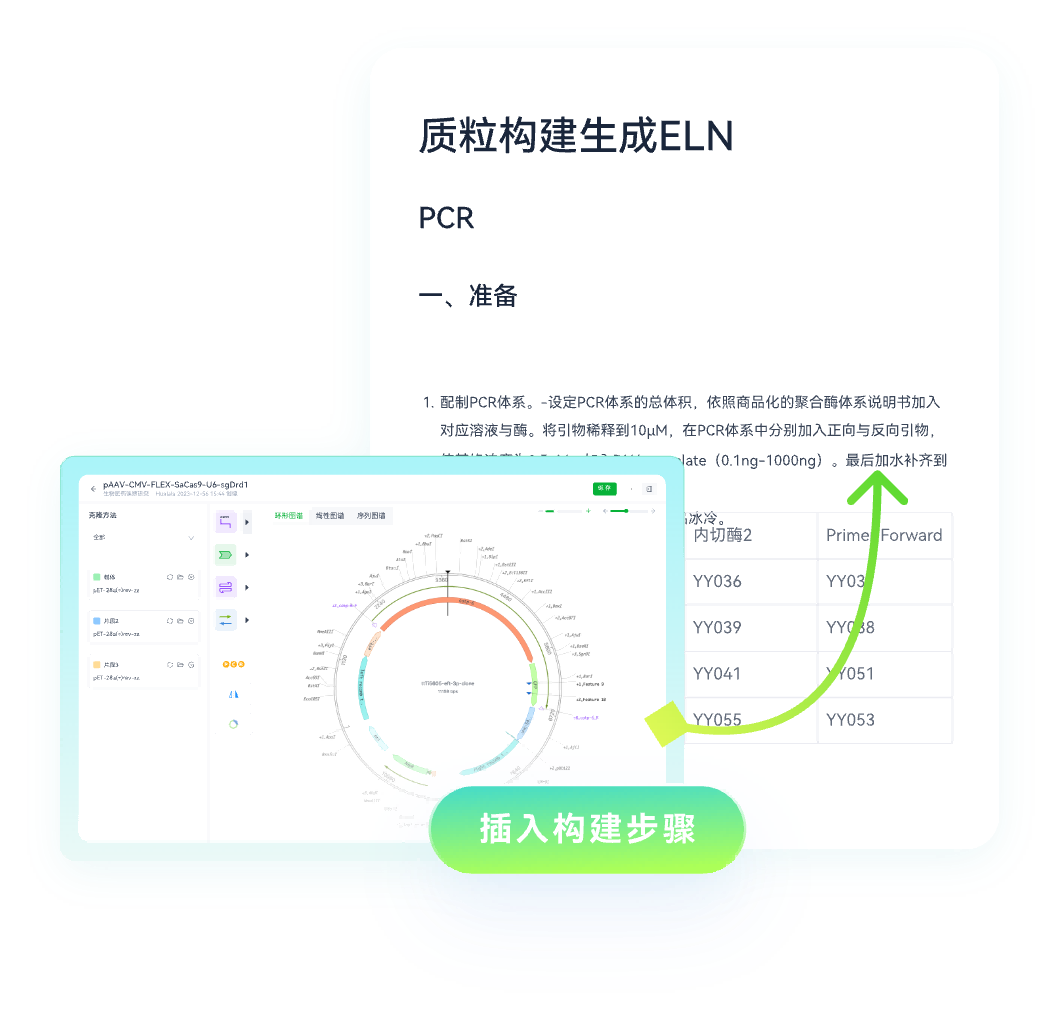
It connects the construct identifier and version, the annotated map, the primer set, and the design rationale to the experiment record, so the full design context travels with the documentation. The experiment record references the construct; the construct record shows all experiments that used it.
What happens without integration?
Without integration, the construct design lives in one tool, the experiment record in another, and the link between them is maintained by the researcher's memory or manual cross-referencing. Over time, these links break, and the team cannot reliably trace results to their design inputs.
Conclusion
Integrating plasmid design software with an ELN connects constructs to the experiments that use them, making cloning traceable and results reproducible. The integration replaces manual cross-referencing with automatic, bidirectional links. A connected R&D workspace that combines design and documentation, such as Zettalab, fits teams whose cloning must be traceable end to end. To integrate plasmid design with an ELN inside a connected R&D platform, explore Zettalab's cloud-based R&D lab platform.
Related Articles